Fordham Notes

Thursday, November 14, 2013

Investors, Investing in the Liberal Arts

Author Robert Hadstrom
What does literature have to do with value investing? What about biology? Or philosophy? Well, according to author Robert Hagstrom, it has quite a bit to do with it, as does physics, sociology, psychology, and all of the other humanities.

At a talk sponsored by the Gabelli Center for Global Investment Analysis on Nov.13, Hagstrom told students that an imaginative investor must look beyond the realm of the business world, as was the main thesis of his recently republished book, Investing: The Last Liberal Art (Columbia University Press, 2013).

Hagstrom, chief investment strategist and managing director at Legg Mason Investment Counsel, said that many of the liberal arts might seem like no-brainers when it comes to investing, in particular the "seductive science" of physics. He used Sir Isaac Newton's second law of action, which states that "for every action there is a second and opposite reaction," as the obvious example.

However, he said, a new school of thought is emerging, one that sees the markets' complex behaviors as more akin to biological science than the mathematical precision of physics.

"Markets are more complex," he said. "They learn to adapt."

As biological conceptions are more complex to comprehend, investors continue to rely on mechanical analogies, he said—although some economists are segueing into studying the markets as complex adaptive systems not unlike the human immune or neurological systems. And although there is plenty of resistance from the "old guard," investors will, increasingly, begin to adopt a biological interpretation of the market.

Moving on to philosophy, Hadstrom called philosopher Lutwig Wittegenstein "the philosophical father of investing." In particular he focused on Wittegenstein’s work in language, honing in on the phrase "the meaning of the word is its use in language."

He went on to explain how language used to describe Amazon in its early days clouded investors' perceptions of the company. Since Amazon started out selling books, many investors first compared the company to Barnes&Noble. As Amazon's inventory diversified, investors began to compare it to Wal-Mart.

But Hagstrom said the comparisons were not accurate. Brokers were concentrating on what the company sold--not on how it was organized. Amazon, he said, was much more like Dell Computers--the single best-performing stock of the 1990s.


When a customer ordered a Dell computer, Dell immediately collected the money and delivered the computer in five days. They didn't need to pay suppliers for another 30, 60, or 90 days—a system known as "negative working capital." Amazon did the same thing.

"Everybody had the same information from the SEC about Amazon, but groups of investors chose different words and those words had different descriptions, and those descriptions had different outcomes."

If the meaning of a word is its use in language, then the "meaning" of a company can be found in language as well.

While Hagstrom acknowledged the difficulty of looking at the market through a variety of academic or literary disciplines, he said doing so would give investors more to draw from when attempting to solve the market problems, and also give them a more enlightened view of the world. 

"Everybody watches CNBC and reads The Wall Street Journal," he said. "[But] you've got to think, 'Every now and then I'll read a detective book to solve problems, because maybe that'll make me a better analyst.'"

"People will notice that you think differently and that makes your more valuable to your company... and it makes you great a cocktail parties too."

--Tom Stoelker

Remembering Pedro Arrupe, S.J.

Today marks the 106th birthday of Pedro Arrupe, S.J. (1907–1991), the 28th Superior General of the Society of Jesus.

Born in in the Basque region of Spain, Father Arrupe is known for his work as a missionary in Japan during the mid-20th century. He was sent to the country in 1938, and in 1945 moved to Nagatsuka, just outside of Hiroshima, to become master of novices at a Japanese mission.

He was in Nagatsuka on Aug. 6, 1945, when the atomic bomb was dropped on Hiroshima, annihilating the city. Having received medical training in Spain before becoming a Jesuit, Father Arrupe attended to as many of the wounded as he could. He and his colleagues gave shelter to 150 victims in their mission, offering food and medical treatment.

In 1965, while serving as Superior of the Japanese Province, Father Arrupe was elected Super General of the Society, a position he held until 1983. During this time, he helped guide the Jesuit community through Vatican II, a turbulent time for the Society. He emphasized a spirituality of engagement and the Jesuits’ obligation to address the needs of the poor, which resulted in the Society working in more hands-on ways with poor communities, especially in Latin America.

This same mission drives Jesuit education, he said, insofar as the “prime educational objective must be to form men and women for others.”

To read more about Father Arrupe, including his arrest and imprisonment shortly after the bombing of Pearl Harbor, read the article by Loyola Press’s Ignatian Spirtuality page.
— Joanna Klimaski

Nothing is more practical than finding God,
than falling in Love in a quite absolute, final way.
What you are in love with,
what seizes your imagination,
will affect everything.
It will decide what will get you out of bed in the morning,
what you do with your evenings,
how you spend your weekends,
what you read,
whom you know,
what breaks your heart,
and what amazes you with joy and gratitude.
Fall in Love, stay in love, and it will decide everything.

— Pedro Arrupe, S.J.

Book Graffiti for the Renaissance


Some call it “doodling;” librarians might even brand it “defacing.”

But to historians, it’s “marginalia.”

On Nov. 12, reading historian Bill Sherman, Ph.D., professor of English at the University of York, delivered the fall Southwell Lecture on visual responses to texts, as expressed in the margins of more renowned Medieval and Renaissance publications.

Erasmus
He framed his talk through the words and works of Erasmus, the Dutch humanist, Renaissance philosopher, and Catholic priest, to illustrate the shifting relationship between reading and seeing in the 16th century, during the advent of printing. 

While Erasmus, it turned out, was a lousy doodler himself (and warned against profane use of religious imagery,) ironically his own image was widely reproduced in his time—through book drawings and doodles, on a coin, and most famously, in a painting (depicted here) by Hans Holbein the Younger. Some of Holbein's earliest surviving work, in fact, is itself marginalia--a set of some 80 drawings (one pictured above) in the margins of one of Erasmus's most famous books, In Praise of Folly.

Erasmus believed that the visual was part of the imagination, and that skillful illustration was a part of storytelling in print. While teaching at Oxford he was also said to have encouraged his students to mark, within the books they read, brilliant passages or maxims.

Manicules (Bembo)
Currently, said Sherman, generalizations about Renaissance marginalia are hard to come by, as “there are a lot out there still to be seen or discovered.” He shared his own enthusiasm for an early printed book, housed at Stanford University, of Pliny the Younger’s Letters in which Italian humanist Bernardo Bembo has added ostentatious pointing fingers (“manicules”) and staring eyeballs (“opticules”) to the margins to accentuate certain passages. He also showed slides from a 1481 copy of Dante’s Divine Comedy with 19 printed illustrations, but which also contained hundreds of visual marginalia by artists—including an “extraordinary map of hell.”

Marginalia, Sherman concluded, do not often compete with the beauty and craftsmanship of great medieval scribes and illuminators. However, they offer a sense of the new mode of interaction during the time, which draws on medieval models but which is also part of an emerging culture of print, as well as the rise of humanism and “commerce with the classics.”

“Even the crudest ones give us a sharper image of  the period eye,” he said. “Like great art, good marginalia have a peculiar power to deliver intimate glimpses of the Renaissance world. And this sense of intimacy is, in the end, the most striking feature in these visual modes of reading.

“[We’re being] allowed to look over the shoulders at the hands of long-dead people, and, with this material, it is beginning to feel as if we might be able to see through their eyes.”

The St. Robert Southwell, S.J., Lecture, given once in the spring and once in the fall, is administered by Susan Wabuda, Ph.D., associate professor of history (wabuda@fordham.edu.)

--Janet Sassi

Wednesday, November 13, 2013

New GBA/PCS Program Gives US/UK Vets Headstart on Startups

Fordham ROTC at Commencement 2013.
Graduate School of Business Administration (GBA) Dean David Gautschi was on-site on Nov. 13 at McMahon Hall for the first info-session for the upcoming US/UK Veterans Entrepreneurship Program, in conjunction with the School of Professional and Continuing Studies.

Gripping a copy of the Financial Times with the headline "Fordham Lends US and UK Military Veterans an Entrepreneurial Hand," Gautschi, himself a military veteran, said the concept for the certificate program was hatched this past June over dinner with several military veterans, several Fordham alumni, and a representative faction from Britain. He added that the program is already creating a bit of buzz in the UK, where it will no doubt rally support in the form of a wintertime fundraiser before the official launch in spring 2014. 

With cohorts attending courses in New York and London, Gautschi explained that though the veterans will be indoctrinated into the contemporary context of business, they'll also explore critical thinking through the reading of literature and plays.

"The whole program is very motivated by the Jesuit approach," he said.

After four weeks of the basics, students begin a social immersion project where they work with a disadvantaged population through a non profit or NGO.

Gautschi said that while the social immersion aspect also exemplifies the Jesuit mission, it also holds practical implications for vets adjusting to civilian life, particularly for those who saw combat and witnessed human suffering.

"Coming back to the comfort of the UK or the U.S., vets have got to understand that the kinds of problems [they saw in battle] persist even here in our own society," he said. "Vets can apply a lot of their experiences, perspectives and even they're training to a disadvantaged population."

Finally, students get to what Gautschi called the "enterprise builder" part of the program.

"That's the guts of it," he said. "For about five months they work with their ideas to see if they can commercialize them and build a business around it."

Students will be coached by mentors through the GBA network, and GBA students will be drafted to take part. The vets will also get subject matter experts to help them "bone up areas they need help with."

Finally they get to stage four, which he called the forum, where vets practice presenting their business ideas to a forum of critics who challenge them. There they learn how to articulate elevator pitches. The last component allows students to pitch to an audience of prospective investors seeking to invest in veteran-related startups. 

"The whole concept of the university is that we want to learn from each other," said Gautschi. "Those veterans who are coming into this exercise are going to teach us as much as we teach them."

--Tom Stoelker

Fordham Panel to Scrutinize Government Spying

Glenn Greenwald
Photo via Wikipedia
Glenn Greenwald, the journalist who Edward Snowden turned to when he leaked documents about the National Security Agency's top-secret surveillance programs, will join a panel of experts on Thursday, Nov. 14 for a discussion at Fordham Law School titled "They're Watching Us: So What?"

For the discussion, which will be held from 7-8:30 p.m. at the McNally Amphitheatre, the Center on National Security has also lined up:


-Bruce Schneier, a cryptographer, computer security and privacy specialist, and author of Liars and Outliers: Enabling the Trust that Society Needs to Thrive (Wiley, 2012)

Chief among the issues they will be tasked with addressing is what we know—and don’t yet know—about how surveillance is reshaping our public and private lives. 

The panel will be moderated by Suzanne Nossel, Executive Director of PEN American Center, and will also try to answer questions such as:

What effect is the expansive American surveillance state having on us? 

Are the programs that Snowden revealed inhibiting the way we think, speak, and create, distorting social interactions, damaging individuals or communities? 

The discussion will be live-streamed at http://www.pen.org/event/2013/10/25/theyre-watching-us-so-what

For more information and to RSVP, visit http://centeronnationalsecurity.org/node/835, or e-mail nationalsecurity@law.fordham.edu 

—Patrick Verel

Tuesday, November 12, 2013

Ignatian Week 2013 at Fordham

Tomorrow is the first day of Ignatian Week, an annual tradition that celebrates the Jesuit spirituality at the heart of Fordham.

Beginning Nov. 13 and continuing through Wednesday, Nov. 20, the Office of University Mission and Ministry and its partners will sponsor a series of discussions, meals, and prayer centered on the legacy of St. Ignatius of Loyola, founder of the Society of Jesus, and the unique spirituality that characterizes the Jesuit Order.

“The Jesuits are renowned the world over for excellence in education, focusing on liberal arts, value-centered education of the whole person, and a commitment to lifelong learning, social justice, and service,” said Carol Gibney, associate director for campus ministry at Lincoln Center and director of Ignatian Programs.

“As a Jesuit institution, the University's principles are based on the 450-year old teaching traditions of St. Ignatius… The Ignatian Week events highlight our rich Ignatian heritage and what it means to be part of a Jesuit university.”

The festivities commence on the Rose Hill campus with “Law and Order: The Jesuit Factor,” presented by Msgr. Thomas J. Shelley, professor emeritus of theology. Msgr. Shelley will discuss the case of New York-based Jesuit Anthony Kohlmann—after whom Fordham’s Kohlmann Hall is named—who was integral to the landmark legal case about the Seal of the Confessional, which prohibits priests from disclosing information learned during the sacrament of penance.

Ignatian Week continues later that evening at the Lincoln Center campus with the fall McGinley Lecture, “To Be a Pilgrim: A Geography of Faith for Jews, Christians, and Muslims,” presented by Patrick J. Ryan, S.J., the Laurence J. McGinley Professor of Religion and Society.

Other upcoming events include:
  • A discussion and guided meditation with Zen roshi (“master”) and Jesuit priest Robert Kennedy, S.J.;
  • An outing at Pugsley’s with America Magazine editor-in-chief Matt Malone, S.J., who will discuss the recent interview with Pope Francis;
  • A trip to Washington, D.C., to participate in the Ignatian Family Teach-In, lobbying for issues of humane comprehensive immigration reform and raising minimum wage;
  • An interactive video conference with Catholic feminist theologians in Asia;
…and more!

To see a full list of Ignatian Week events, visit Campus Ministry’s website.

— Joanna Klimaski

Monday, November 11, 2013

Army Veteran Bobbie Scroggin is Fordham's Boxing Philosopher

Scroggin took classes at all three of Fordham's New York campuses to get her degree.
(Photo:Tom Stoelker)
Bobbie Scroggin, PCS '12, is a veteran, a boxer, a mom, and philosopher—though not necessarily in that order.

After Scroggin left the U.S. Army, she had a two children, a girl in 2006 and a boy in 2007. Two years later she accepted a full-time position as administrative assistant at U.S. Military Academy at West Point. She filled what little spare time she had coaching the academy's women's boxing team.

When asked how she managed it all, she claims she had a doppelganger.

Eventually, Scroggin realized that she needed to shift the focus back to herself and her family. She began taking classes at Fordham's School of Professional and Continuing Studies, and thus began an unexpected philosophical journey.

For Scroggin, Fordham offered a combination of location and well organized scheduling that allowed her to, in some cases, "knock out a whole class over five Saturday sessions." For a single mom of two, PCS's flexibility proved invaluable.

What she didn't expect, however, was that the core curriculum requirement of two theology courses and two philosophy courses would alter the course of her studies and change her manner of thinking. 

"I was like, 'Aww, do I really have to take philosophy?'" she recalled. "But in the end I was really glad, and now that's my major at Columbia."

Since graduating from PCS with a bachelor's degree in organizational leadership, Scroggin has gone on to pursue a master's degree in philosophy and education at Columbia University's Teachers College. She expects to graduate next year.

Given her experience living in Afghanistan, Germany, Hawaii, and her native California, Scroggin had a natural inclination to process events philosophically, but it wasn't  until she came to Fordham that she embraced it as a discipline. She said her studies have informed her dating life, her work life, and her life as a mom.

"I subconsciously teach my kids philosophy, logic, and reasoning," she said, joking that it has caused occasional discord.

"Now when my kids are arguing with me, they always ask me ‘Why?,’ or 'What if you did it this way?'"

She said that at West Point, her colleagues sometimes need to remind her that she's in the U.S. Army and the modus operandi there is to take orders.

"I always ask why, and my colleagues say, 'Come on, we're the Army--we just do!'"

--Tom Stoelker

Friday, November 8, 2013

Fordham Welcomes Jesuit Superior General to Campus

Adolfo Nicolás, S.J., Superior General of the Society of Jesus,
celebrates Mass in University Church at Fordham.
Photo courtesy the Society of Jesus' New York Province

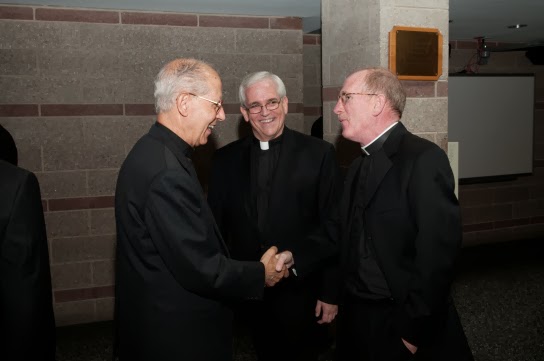
Fordham welcomed a notable member of the worldwide Jesuit community to campus recently, when Adolfo Nicolás, S.J., Superior General of the Society of Jesus, made a stop during an official trip to the United States.

The visit was part of a two-week tour to meet with American Jesuits and Jesuit scholastics, visit Jesuit high schools, and speak with administrators of Jesuit colleges and universities. The trip was Father Nicolás’ second visit to the United States since being elected Superior General of the order in 2008.

While in New York, Father Nicolás met with Jesuits in formation, visited retired Jesuits at the Murray-Weigel Jesuit Community, and celebrated Mass with 150 Jesuits, lay directors, and staff from the New York province.

“Father Nicolás encouraged us to go deep in our prayer, work, and study, that this is what we can offer the church and the world,” said Thomas Scirghi, S.J., associate professor of theology and rector of the Jesuit Community at Spellman Hall.

“He is concerned that many Jesuits wear too many hats, spreading themselves too thin. The danger here is it keeps you on the surface and prevents you from plunging deeply into any one type of work.”

In addition to New York, Father Nicolás traveled to Boston, St. Louis, and Chicago. He concluded his trip with the presidents, administrators, and board members of the Association of Jesuit Colleges and Universities (AJCU), an organization that represents the 28 Jesuit colleges and universities in the United States.

At the gathering, Father Nicolás broached a topic that he said has not yet been fully confronted: the future of Jesuit schools in the face of changing demographics.

“In 1973, there were about 212 million Americans; today there are about 316 million. That means that if the number of Americans per Jesuit institutions of higher learning had been kept constant, there should be 42 AJCU institutions today,” Father Nicolás said. “And since 1973, the number of U.S. Jesuits has declined from 6,616 to 2,547. This means that if the total number of U.S. Jesuits per AJCU institution had been kept constant, there should be only 11 Jesuit colleges and universities today.

“Since the supply of Jesuits is increasingly limited while the demand for more Jesuits seems to always expand, it would seem that some changes are in order.”

These changes are already happening—for instance, a number of AJCU presidents are not Jesuits, and some are not Catholic. Such changes reflect the important role that the laity plays in the Society’s mission, Father Nicolás said; but it is crucial that the 28 AJCU institutions and the Society of Jesus ensure their relationship does not become “stretched so thin that it becomes impersonal and meaningless.”

“[I have no doubt] you are capable of undertaking bold challenges and that you are ready to do whatever is necessary to serve this important ministry that serves so many individuals, so many communities, to say nothing of the Lord and his church,” he said. “You have the talents and temperament, the head and heart, to do what needs to be done.”

For the full text of Father Nicolás' remarks to the AJCU, read the transcript in America Magazine.

Father Nicolás with David S. Ciancimino, S.J., provincial of
the Society of Jesus' New York Province,
and Joseph M. McShane, S.J., president of Fordham.
Photo courtesy of the Society of Jesus' New York Province

— Joanna Klimaski

Thursday, November 7, 2013

VIDEO: Fordham Leaves

With midterms past the rhythm at Fordham Rose Hill returns; the comings and goings of students become as dependable as the University Church bell toll at noon.     


-video by Tom Stoelker

Fordham Professor Identifies New Dolphin Species


A humpback dolphin
Humpback dolphins plying the waters in four regions of Africa, India and Australia look very similar, but are in fact separate species, according to a new study released last month.

The findings were reported in the October issue of the journal of Molecular Ecology, in a paper titled "Integrating multiple lines of evidence to better understand the evolutionary divergence of humpback dolphins along their entire distribution range: a new dolphin species in Australian waters?" 

Sergios-Orestis Kolokotronis, Ph.D., assistant professor of biological sciences at Fordham, co-authored the study, which involved extracting 235 tissue samples and 180 skulls throughout the animals’ distribution, representing the biggest dataset assembled to date for the animals.

The goal of the study is to aid in the conservation of the dolphins (genus Sousa) by getting a better understanding of what makes them distinct. 

Each dolphin occupies a different section of ocean around the world, including in the Atlantic ocean off West Africa (Sousa teuszii), in the central to western Indo-Pacific ocean (Sousa plumbea), in the eastern Indian and western Pacific ocean (Sousa chinensis) and a new, as of yet named species off northern Australia.

Kolokotronis' study and his perspectives on what makes a species were featured in a recent article on the Smithsonian Magazine's blog

—Patrick Verel