Fordham Notes

Thursday, November 7, 2013

GSS to Hold Memorial Lecture for Dean Emeritus


Bryan Samuels
James Dumpson, Ph.D
Tuesday marked one year since Fordham lost one of its most esteemed scholars, James R. Dumpson, Ph.D., a tireless advocate for the poor and a former dean of the Graduate School of Social Service (GSS).

Next week, GSS will host a memorial lecture to honor Dumpson, who died Nov. 5, 2012 at the age of 103.

James R. Dumpson Memorial Lecture
Tuesday, Nov. 12 | 4 p.m.
Corrigan Conference Center / 12th-Floor Lounge
Lincoln Center Campus | 113 West 60th Street, NYC 10023

The featured speaker will be Bryan Samuels, executive director of Chapin Hall Center for Children in Chicago and former commissioner of the Administration for Children, Youth, and Families. Samuels’s lecture will center on child welfare, a topic about which Dumpson was passionate.

The memorial lecture is part of an ongoing series associated with the James R. Dumpson Chair in Child Welfare Research, a position created in 1980 to honor Dumpson and utilize the University’s education and research resources to improve the quality of life for vulnerable children.

The chair, which is currently held by Brenda G. McGowan, D.S.W., evokes Dumpson’s commitment to children by focusing its teaching, research, and advocacy on New York City children most in danger of losing their rights or not enjoying an adequate quality of life.

A reception will follow the lecture. RSVP by emailing Priscilla Dyer, or call (212) 636-6623.

Dumpson began at Fordham in 1957 as a visiting associate professor in the Graduate Institute of Mission Studies. After leaving to serve as deputy commissioner in the Department of Welfare, he returned to Fordham in 1967 to take the helm at GSS, becoming the first African-American dean of a non-black school of social work.

To read more about Dumpson and see a timeline of his career highlights, click here.

Read Dumpson’s obituary in The New York Times here.

— Joanna Klimaski

Wednesday, November 6, 2013

Faculty Spotlight 2013 Carves Space

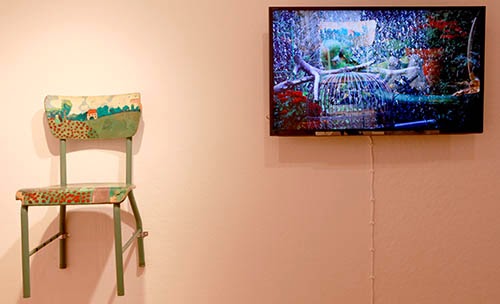
Ross McLaren's "Into the Garden."
Video, architecture, and painting are relatable yet distinct disciplines. For the Ildiko Butler Gallery's annual faculty show, which opens Nov. 5, the media are threaded together as three distinct interpretations of space.


Within the limitations of the three-walled gallery, Faculty Spotlight 2013 doesn't attempt to create connections that aren't there. Instead three zones are neatly mapped out for participating faculty: William Conlon, Sandra McKee, and Ross McLaren. The viewers are left to make their own connections.

Conlon provides text that guides the viewer through his three paintings on display, albeit in an abstract manner. He writes that his influences range from the Hadron Collider, to Rothko, and YouTube. A portrait of the artist in front of graffiti hints yet another influence--think Matisse meets the South Bronx. The paintings are acrylic-on-archer-paper mounted on board. He describes the works as comparable to a funhouse mirror, "forcing you to see things in a different way."
McKee's origami chair models.


In the case of architect Sandra McKee, various built and proposed projects created with her partner Hiroki Yoshihara are accompanied by wall texts explaining the intentions in classic architectural language. As part of their research, McKee and Yoshihara experiment with origami, a kind of polar opposite to architect Frank Gehry's crumpled-paper explorations. Viewers can compare and contrast the firm's interlocking spaces to their folded "origami chair" models nearby.

Lastly, there is McLaren's "Into the Garden," in which the artist leaves interpretation entirely up to the viewer. There is no accompanying text. While McLaren's impressive biography reassures visitors of his credentials, he doesn't explain. His piece is simply a child's chair mounted onto a wall beside a large digital screen, projecting an image of a parrot and a reflected image of the chair. Is the video shot through glass that reflects the chair? Is the parrot added in postproduction?  The reality is amorphous, but the chair mounted on the wall attests to its reality.

As to the question of space, one is left grasping at the space between inspiration and the reality of the thing: the leap from Hadron Collider to acrylic painting; from experimental origami and split level architecture, and from a child's chair to it's digital reflection.

Conlon's "Saratoga."

The show runs through Jan. 17.

--Tom Stoelker

Shakespeare, Papal Power, and the Death of Kings

In Shakespeare’s Hamlet, Marcellus declares, “Something is rotten in the state of Denmark.” Published in 1603, at the end of Queen Elizabeth’s reign, the tragic play can be read as a reflection of the politics of the day in England, said Arthur Marotti, Ph.D., FCRH ’61, a Shakespeare scholar, in a lecture at the Rose Hill campus on Oct. 22.

“In the last years of Elizabeth’s rule people believed something was rotten in England—though perhaps not rotten enough to justify regicide,” as in Hamlet, “a play inordinately preoccupied with king-killing,” said Marotti, Distinguished Professor Emeritus of English at Wayne State University.

In his lecture “Shakespeare, Tyrannicide, and the Papal Deposing Power,” Marotti laid out the prominent religious and political struggles of late 16th-century England and discussed how they informed Shakespeare’s plays.

“William Shakespeare repeatedly dramatized king-killing and the planning of king-killing,” Marotti said, a dangerous act in a country that could stretch the definition of treason to include even thinking about the death of a monarch. “Perhaps this is one reason why the act itself often takes place offstage, instead of being presented vividly onstage for absorption in the memory and imagination of spectators.” Regicide is depicted or alluded to in many of the bard’s plays, including Julius Caesar, Macbeth, Hamlet, and King Lear, with threats to nobles in Henry IV, Part 1 and The Tempest.
William Shakespeare

In Richard II, for example, Shakespeare depicts a weak monarch, King Richard II, who is succeeded by a strong leader, King Henry IV. Henry takes the crown following an onstage assassination “prompted by a clear signal from the new king that [Richard] needed to be killed—though Henry pretended he had expressed no such wish,” said Marotti.

Richard II was written and performed during an especially tumultuous time in England, when assassination attempts on Queen Elizabeth abounded. It was also a time of great tension between Catholics and Protestants. In 1570, Pope Pius V issued Regnans in Excelsis, a papal bull formally excommunicating the Protestant queen, declaring her a heretic and absolving her subjects of any allegiance to her.

Marotti said that the papal bull was “an extreme case of [the Catholic Church] using the power the papacy claimed it had,” the power to exert both religious and political influence in England. But it was “a watershed event” for the country, contributing to “the nascent historical narrative of England as a fundamentally Protestant nation threatened by international Catholicism.”

When Pope Gregory XIII came to power in 1572, he tried to ease the bull’s harsh effects on English Catholics, who feared retaliation from authorities. Marotti said that Catholics were urged by the papacy to continue practicing their religion, but, if possible, should work to overthrow, or even kill, the queen as a “heretical tyrant.”

The queen was haunted by worries of assassination. Religious fanaticism in the late 16th century brought about the deaths of several European rulers: Henry III and Henry IV of France and William of Orange. But killing a reigning monarch, because it was both morally wrong and sacrilegious, said Marotti, required compelling political and theological justification.

“On neither side was toleration or religious pluralism a desirable policy since all conceived of church and state as inextricably bound,” Marotti said.

Where did Shakespeare’s sympathies lie? Recent scholars conclude that it’s impossible to determine whether he was a Protestant or a Roman Catholic based on his writings, said Marotti, but the plays do show sensitivity to his religiously mixed audiences.

“He consistently avoided crude religious or political propagandizing,” Marotti said. “Political resistance, regicide, and tyrannicide were for him good dramatic materials, but they led him to explore their human, social, moral, and religious dimensions and to engage his audience in this effort.”

Four hundred years later, Marotti said, the playwright’s words continue to test theatergoers’ moral imagination.

“The prompts are Shakespeare’s; the conclusions we reach are ours.”

The lecture was sponsored by the Department of English, the Comparative Literature Program, and the Francis and Ann Curran Center for American Catholic Studies at Fordham University. It marked Marotti’s first time back on the Rose Hill campus since 1961, when he earned a bachelor’s degree in English. He spent part of the day touring the campus and meeting with students at the University and at Fordham Preparatory School, his high school alma mater.

“I spent eight years here and they did leave an indelible mark on me,” he said before his lecture in Tognino Hall. “I learned how to study, how to work hard, and those qualities …. have stayed with me since that time.”

—Rachel Buttner

Tuesday, November 5, 2013

Alumni Spotlight: A Fordham Couple Gives Back

For Bridgette Catino, FCRH ’07, and Greg O’Brien, GSB ’07, Fordham holds many fond memories. It’s where they earned a Jesuit education, participated in student activities, and fell in love. Now, as members of the Young Alumni President’s Club, they celebrate their Fordham memories while helping current students make their own.

Since graduating in 2007, Catino and O’Brien have been loyal donors to the University, giving each year “to show our gratitude and school pride,” says Catino. “We choose to give, to help make [Fordham] even better and give other students the opportunity to attend this great university.”

A native of Minneapolis, Catino came to Fordham because she wanted to study in New York City, preferably at a Catholic university that offers a dance program. She had been training as a dancer since she was 3, and applied to Ailey/Fordham B.F.A. in dance program at Fordham College at Lincoln Center, but after visiting the Rose Hill campus, she transferred her enrollment to Fordham College at Rose Hill, where she majored in communication with a minor in business.

She also found a creative outlet for her passion. For four years, she was a member of the student-run dance company, Expressions Dance Alliance, and Fordham’s dance team, Ram Rhythm. She now volunteers as a dance instructor at Liberated Movement, a nonprofit, donation-based dance company in Tribeca.
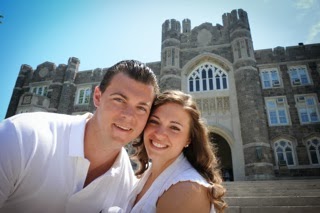
Greg O'Brien, GSB '07, and Bridgette Catino, FCRH '07,
in front of Keating Hall


Catino says her Fordham education, coupled with the support she received from the University’s Office of Career Services, helped her earn a job at CBS Corporation. She started working there as an intern in the research department during her junior year, and is now a director in the advertising sales department. “CBS is situated within the communication world,” she says, “but I do read balance sheets and annual reports, so the [business] minor has been helpful.”

Her junior year at Fordham was especially memorable for another reason. It’s when she met her future husband, Greg O’Brien, on the fourth floor of O’Hare Hall Residential College. They started dating during their senior year and married in September 2012.

“Fordham was the best four years of my life,” says O’Brien. “I have friends I’ll have forever. I met my wife there. [It’s great] what it has done for me in my life.”

O’Brien, who is from Edison, N.J., grew up familiar with Fordham. His grandfather Thomas Garrubbo is a 1942 graduate of Fordham College at Rose Hill, and one of his cousins, Kimberly Spiessbach, graduated from Fordham Law in 1998. “That was a big decision factor in attending,” he says, “but [it was also about] falling in love with the look of campus.”

After graduating with a B.S. in finance from the Gabelli School of Business, O’Brien started working at Allied Irish Bank, where he soon discovered several Fordham connections. In fact, he has counted Fordham alumni among his colleagues and supervisors at all three of his post-college jobs, including his current position as an assistant vice president in U.S. Bank’s Education and Nonprofits Division.

Active students at Fordham—O’Brien was in the Sixth Man Club and played intramural softball, and Catino was in the Fordham University Emerging Leaders Program and the Fordham Club—they find many ways to give back to their alma mater.

“Fordham helped reinforce the Christian values we grew up with and provided opportunities for us to get involved in the community and around campus to give back,” says Catino.

They attend football and basketball games, Expressions performances, Homecoming, and other alumni events. They also give back as members of the Young Alumni President’s Club (YAPC).

YAPC, a donor recognition society at Fordham, recognizes recent undergraduate or graduate alumni who give back to their alma mater. For those graduates from the classes of 2004 to 2008, membership is based on an annual gift totaling $500 or more; from the classes of 2009 to 2013, it is $250 or more.

Catino and O’Brien support the University’s annual fund, the Fordham Fund, and the Fordham College at Rose Hill and Gabelli School of Business funds. And, as part of YAPC, they receive exclusive invitations to professional networking and social gatherings.

“Ours and other alumni donations demonstrate our collective appreciation for what Fordham has and will continue to provide us throughout our careers and lives,” says O’Brien.

“We think it’s important to help Fordham maintain its esteemed academic status and to continue to provide the same kinds of positive experiences for students that we had, for years to come.”

To learn more about the Young Alumni President’s Club, visit www.fordham.edu/yapc.

—Rachel Buttner

Monday, November 4, 2013

Professor Christina Greer to provide analysis during NYC elections


Christina Greer, assistant professor of political science, will be a busy bee providing analysis during the New York City elections on Nov. 5.

Greer will appear on CNBC’s “Worldwide Exchange” at 5:20 a.m., and later that evening, she’ll join a panel to provide live analysis on NY1 when the polls are open. She’ll likely be on to provide more analysis once a winner is declared.

Greer was quoted by the Associated Press in a story that appeared nationally over the weekend about the race to succeed three-term Mayor Michael Bloomberg.

“It seems like the city wants a Democrat right now,” said Christina Greer, political science professor at Fordham University. “Five terms of heavy-handed government has tired people out. People are ready for something different.”

This caps a busy year for Greer, whose newest book, “ Black Ethnics:  Race, Immigration, and the Pursuit of the American Dream (Oxford University Press, 2013), was published earlier this fall. Watch a video interview with Greer about the book via NY1 on Fordham’s YouTube channel, where you can find several video clips of our faculty in the media.

-Gina Vergel

Friday, November 1, 2013

Celia Fisher to talk ethics of surveillance on Al Jazeera America


What does it mean to live in a surveillance state? The Al Jazeera America program, Fault Lines, investigates the fallout over the National Security Agency's mass data collection programs in the U.S. and abroad. 
Ethics expert, Celia Fisher, Ph.D., the Mary Ward Doty Endowed University Chair and Professor of Psychology, is featured in the program, which premieres on Al Jazeera America on Friday, Nov.1, at 10:30 p.m. ET. The program will repeat on Al Jazeera America on Nov. 2, at 7p ET, and then air on Al Jazeera English on Nov. 6, at 6:30p ET.
In the episode, Fisher discusses the psychological effects and ethical implications of surveillance. The program will also feature in-depth interviews with journalist Glenn Greenwald and NSA director Keith Alexander.

- Gina Vergel


Thursday, October 31, 2013

IIHA Founder Celebrates Book Launch


Kevin M. Cahill, M.D., University Professor and Director of the Institute of International Humanitarian Affairs, was honored on Oct. 28 with a party celebrating the publishing of the second edition of To Bear Witness, (Fordham University Press, 2013). 

The book, which is the latest release in an International Humanities Affairs series edited by Dr. Kevin Cahill, followed the spring publishing of History and Hope.

The party took place at the 21 Club in Midtown Manhattan and was hosted by Tom Brokaw, Roy Lennox, and Bob Pittman. Also in attendance was Stephen Freeman, Ph.D., Fordham's Provost and Professor of Ecology and Evolutionary Biology.

—Patrick Verel


Once Upon a Midnight Dreary...

In 1846, Fordham gained a thoughtful, well-mannered neighbor who would become a regular visitor to the Jesuit fathers on campus. In June of that year, he moved into a white three-room cottage on Kingsbridge Road, overlooking the campus of Fordham (then named St. John’s College).

When his wife died seven months later, he began the long walks that would lead him to the campus of St. John’s. There, he befriended college president Auguste J. Thebaud, S.J., as well as future president Edward Doucet, S.J., with whom he often walked the campus grounds, unburdening himself and taking a break from his literary efforts.

The Jesuits often gave him free rein in their library, where he would stay late into the night. “He was well informed on all matters” and was “a gentleman by nature and instinct,” Doucet said of the man, who had the now-familiar name of Edgar Allan Poe.


The Edgar Allan Poe cottage on Kingsbridge Road in the Bronx.

— Chris Gosier

Wednesday, October 30, 2013

Feared Zombie Takeover of Rams Fitness and Rec


Zombies are expected to take over the Recreation and Fitness Center tomorrow, Oct. 31, 6:30 p.m. at Fordham's Rose Hill Campus, according to Sarah Bickford, administrator of Fitness and Recreation.

"Normally we have a hip hop fitness class, but instead we're doing the Michael Jackson Thriller dance," explained Bickford, who added that there will also be a Spooky Spin cycling class at 6 p.m. set to scary music.

"I'm hoping the students will come before they go out trick or treating," she said.

The session will be taped so that students will get a chance to post later.

The Halloween-themed event is part of Bickford's effort to focus on themed classes. She added that there are other holiday opportunities, such as seasonal meal planning with the Center's nutritionist, something she said is not always available in the real world.

Both the spin and dance classes are costume optional.

For more info contact: Sarah Bickford (718) 817-3815, sbickford@fordham.edu

Tag your Halloween pics with #fordham #halloween!

Monday, October 28, 2013

Fordham to Mark Hurricane Anniversary with "Sandy Saturday"


Oct. 29 marks one year since Hurricane Sandy struck the east coast, causing more than 100 deaths and as much as $65 billion in damages. In New York alone, hundreds were displaced as flooding, severe winds, and, in some cases, fire destroyed entire neighborhoods.

Fordham University is marking the anniversary of Hurricane Sandy with a service trip to help local individuals and families who continue to struggle, and to raise awareness about the continued physical, financial, and spiritual needs of these communities.

On Saturday, Nov. 2, the Fordham University Sandy Solidarity Committee will sponsor its final “Sandy Saturday” to work with affected communities. Volunteers will travel from campus to the Far Rockaways to join Habitat for Humanity in helping clear debris, gut devastated homes, and assist in the ongoing rebuilding efforts.

According to Gil Severiano, assistant to the vice president of campus ministry, the hope was that, by sponsoring a trip near the anniversary of the storm, Fordham could turn a spotlight on the devastation that hurricane victims continue to grapple with.

“There is still a lot of work to be done,” Severiano said. “There are whole lots that are still empty, and people who are have only just begun returning to their homes.”

Since the storm hit, the University has run more than a dozen trips to the Rockaways, Breezy Point, and other affected areas. More than 400 students, staff, faculty, alumni, and friends have participated in these official Sandy Saturdays, although Severiano said the unofficial number is much higher.

“The Fordham response was immediate and sustained,” she said. “In addition to our trips, people were going out in solo groups. The Lincoln Center students, for example, did a phenomenal job of organizing themselves to collect donations and run trips.”

The University will also hold a prayer service Oct. 29 at 6 p.m. on the Gabelli Plaza, outside Hughes Hall. A reception and reflection will be held in the McGinley Ballroom directly following the service.

In addition, the collection at this Sunday’s Mass was dedicated to the hurricane victims.

“Campus Ministry is happy to continue accepting donations on behalf of Catholic Charities, Habitat for Humanity, and others working in these areas. People can also donate directly to these organizations,” Severiano said.

“We live here, these are our neighbors. We need to support our local community.”

To register for Saturday’s trip, click here and fill out the registration form

For information about either the trip or the prayer service, contact campus ministry at (718) 817-4500.

To read about earlier Sandy Saturday efforts, read the article on Fordham’s news blog

--Joanna Klimaski