Fordham Notes: Biological Sciences
Showing posts with label Biological Sciences. Show all posts

Tuesday, June 17, 2014

Study Highlights Extreme Rainfall as Unexplored Area of Research

Scientists agree that one of the effects of global climate change will be major changes in the amount and timing of rainfall. 

And while many studies have been conducted to gauge the reaction of plants to draughts, less has been done to learn what happens to plants when it rains a lot, or at unusual times.

In a new paper published by the journal Biogeosciences, James Lewis, Ph.D., professor and chair in the Department of Biological Sciences at Fordham, helped shed some light on the current gaps in research. 

“Impacts of Extreme Precipitation and Seasonal Changes in Precipitation on Plants” is the result of a collaborative effort between Lewis and Melanie Zeppel and Jessica Wilks of Macquarie University, Sydney. 

It’s a global review of how plants respond to extreme precipitation in different ecosystems around the planet, such as dry grasslands, woodlands, warm humid tropical rainforests, savannas, as well as cold deserts. 
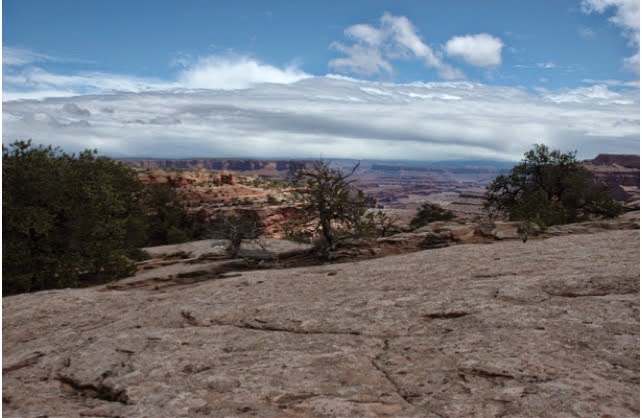
Plants from one of the study regions, cold desert Canyonlands National Park, Southern Utah.
Photo by Patrick Hudson
Because changes in both the amount and timing of precipitation change soil water content, plant growth is likely to be affected. This has implications for food production, forestry industry, biodiversity and carbon and water cycles. Pests, pathogens and invasive species are likewise influenced by extreme precipitation changing soil water content.

Lewis said the review, which involved thousands of papers going back 30 years, came about after they began examining the studies already done on savannahs, for a study they plan to conduct on this topic. They found that some manipulative studies have been done on grasslands and on temperate and tropical forests, but that’s about the extent of it. 

Scientists can make general predictions about plants and rainfall based whether plant’s soil bed is of sand or clay, whether the roots go deep or shallow, and whether a plant has a short or long lifespan. 

But no one knows just how differently tropical forests will respond, compared to boreal forests in the Arctic or even deserts. Of special concern is how studies point toward a need for greater irrigation of agricultural systems, which will likely experience less rainfall.

“Precipitation patterns are likely to vary in many parts of the planet,” Lewis said. 

“And in areas that are relatively wet, this may have negative consequences for plants, particularly if those changes in rainfall are reductions in the amount of rain during the growing season.

Other areas may actually benefit, however, “because the rainfall may actually increase during the periods when plants are growing and decrease during the periods when they’re not.”

Lewis said the study can serve as a road map for future studies of extreme precipitation.

“We don’t view the review as definitive; we view it as pointing out the next steps,” he said.


—Patrick Verel

Thursday, November 7, 2013

Fordham Professor Identifies New Dolphin Species


A humpback dolphin
Humpback dolphins plying the waters in four regions of Africa, India and Australia look very similar, but are in fact separate species, according to a new study released last month.

The findings were reported in the October issue of the journal of Molecular Ecology, in a paper titled "Integrating multiple lines of evidence to better understand the evolutionary divergence of humpback dolphins along their entire distribution range: a new dolphin species in Australian waters?" 

Sergios-Orestis Kolokotronis, Ph.D., assistant professor of biological sciences at Fordham, co-authored the study, which involved extracting 235 tissue samples and 180 skulls throughout the animals’ distribution, representing the biggest dataset assembled to date for the animals.

The goal of the study is to aid in the conservation of the dolphins (genus Sousa) by getting a better understanding of what makes them distinct. 

Each dolphin occupies a different section of ocean around the world, including in the Atlantic ocean off West Africa (Sousa teuszii), in the central to western Indo-Pacific ocean (Sousa plumbea), in the eastern Indian and western Pacific ocean (Sousa chinensis) and a new, as of yet named species off northern Australia.

Kolokotronis' study and his perspectives on what makes a species were featured in a recent article on the Smithsonian Magazine's blog. 

—Patrick Verel


Friday, December 17, 2010

FORDHAMScience: One Fish, Two Fish…

Biologists spend a lot of time studying tiny details to come up with the answers to big questions. Rose Carlson, assistant professor in Fordham’s Department of Biological Sciences, is making a career of darters, fish in the perch family that inhabit the rivers and streams of North America, and most species of which are under three inches in length.

Carlson, who took her doctorate in population biology from U.C. Davis, has logged thousands of hours in the lab and in the field taking note of minute distinctions between darter species from streams in the southeastern United States.

“I’m interested particularly in the diversity of characteristics that have some kind of important function for the species,” Carlson says. “In my dissertation work I focused on characters of the [darter] jaws that we know are going to affect what the species are eating. When you see differences among species in jaw shape you can infer with pretty high confidence that it correlates as in what they’re eating. And then when you put species with different jaw shapes in a community, you can then make another inference: which is that they’re all eating different things, and that perhaps this diversity facilitates coexistence.” (See: “The ecological morphology of darter fishes,” with Peter C. Wainwright, Ph.D.)

One aspect of Carlson’s research is looking at species coexistence and community assembly: how different species can populate a given habitat—in this case some very shallow streams in upstate New York, Tennessee and northern Georgia, to name a few. Small as these streams are, it’s the bottom inch or two that most concerns Carlson: that’s where darter habitat mostly lies, in a slower boundary layer between the streambed and the faster moving water above it.

Her post-doctoral work has focused on understanding the function of differently shaped and sized fins in darter fishes. Darters mostly hold their place on the streambed, eating what is directly in front of or very near them. Occasionally they will dart forward for a morsel of food, or to avoid a predator (mostly birds and bigger fish).

“They kind of sit, for a long time and then move very quickly, explore their area, dart again, sit. That’s kind of the cycle,” Carlson says. “They eat things that are on the bottom for the most part, on the sides and sometimes on tops of rocks—a lot of aquatic invertebrate larvae.”


Right now Carlson measures the maximum stream flow speed in which darters can stay in place. The fish are set up in Plexiglas recirculating flow tanks and given time to acclimate (“They’re freaked out when you first put them in there,” she says). The flow is generated by a propeller calibrated so that the researchers know the flow speed in the tank for set numbers of revolutions per minute. The tanks are filled and the researchers move the darters into a standard position, sitting on the bottom—holding station—and then slowly turn up the flow speed, from a very low speed up to the maximum speed at which the fish can hold position.

“You can see when they start to struggle to hold position,” Carlson says. “That’s one of the types of test that we would do. At other points, when we’re interested in visualizing flow patterns, we’re just interested in having the fish sit in a particular position for a long period of time, not necessarily at its maximum flow speed, just visualizing the water movement over the fin and over the substrate.”

The researchers capture the darters on high speed video. For some of the performance studies they have two views: lateral and dorsal, to capture motion from the side and top. “It’s all contingent upon them having the same type of locomotor behavior,” Carlson says. “If we find they have the same habitat and the same fin shape, that’s strong evidence that fin shape is somehow adaptive in that type of environment.”

The next step, according to Carlson, is to get out in the field and “really make very close observations on what darters are doing,” by measuring where they are in the habitat. She wants to get a better idea of how the laboratory findings translate to nature. That will mean lying in a stream (either in a wet suit or dry suit, depending upon the water temperature), at eye-level with the tiny fish. Carlson says a flow meter that will work in such shallow water is “going to require a little bit engineering and ingenuity… But that’s one of the fun things about fieldwork.”

Monday, December 8, 2008

Seminar: The Changing Landscape of Conservation

John G. Robinson, Ph.D., executive vice president for conservation and science at the Wildlife Conservation Society (WCS), will lecture on “The Changing Landscape of Conservation,” on Thursday, December 11, 2008, at 6 p.m. in the Flom Auditorium, Walsh Family Library, Rose Hill Campus.

Robinson will explore the intersection of conservation and science and how the conservation movement is adapting to confront increasingly complex and global issues in the conservation of biodiversity in this seminar sponsored by the Department of Biological Sciences at Fordham.

Robinson oversees WCS conservation programs in the Americas, Africa and Asia. He received his doctorate in zoology from the University of North Carolina in 1977, focusing on primate behavior and ecology. His postdoctoral studies were with the Smithsonian Institution. In 1980, Robinson established the University of Florida Program for Studies in Tropical Conservation, a graduate program providing training to students from tropical countries. Robinson joined WCS in 1990 as director for international conservation programs. He is past president of the Society for Conservation Biology, on the steering committee of the IUCN World Conservation Union’s species survival commission, and the executive committee of the IUCN’s sustainable use initiative.

For more information, please contact J. Alan Clark, Ph.D., J.D.: jaclark@fordham.edu, (718) 817-3678.