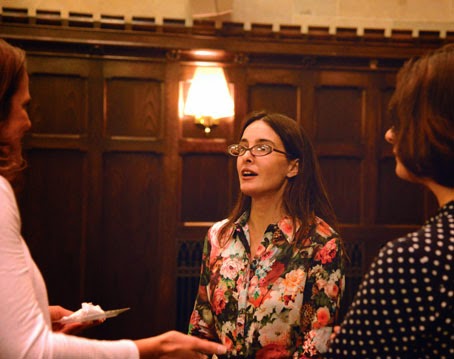
“I was watching their passion for critiquing hookup culture once they figured out they weren’t alone, about how before they pretended it was awesome, but how it’s actually kind of awful,” Freitas told to a gathering of Fordham alumni, students, and faculty in Tognino Hall on Sept. 8. “They felt like they had been abandoned by the Catholic tradition to wallow in college without anything useful or practical to [guide] them. They wanted guidance.”
Curious to know if other students felt the same way, Freitas began crisscrossing the country visiting four types of colleges—Catholic, evangelical Christian, private, and public—to study students’ attitudes about sex and faith. She shared her findings in her book Sex & the Soul: Juggling Sexuality, Spirituality, Romance, and Religion on America’s College Campuses (Oxford University Press, 2008).

As part of Freitas’ study, more than 2,500 college students at seven campuses participated in an online survey, and she conducted one-on-one interviews with more than 100 students. She found that while students were interested in spirituality, and 80 percent of them identified as “spiritual, or religious to some degree, “even at a non-religious affiliated college, they often felt uncomfortable speaking about it outside the classroom setting.
It was much the same way with dating; students were interested in finding romance, but were hesitant to act upon their desires or even talk about it with friends and peers. “Students would say, ‘I want romance but I can’t admit that.’ Or ‘My parents did that, but that doesn’t really happen in my generation anymore.’ It was an anxiety around a wish for dating, but also this anxiety around [dating],” said Freitas, now a research associate in the Center for the Study of Religion and Society at the University of Notre Dame.
Freitas said 78 percent of the students she surveyed saw romance as “virtually asexual.” “Students very rarely—I can’t tell you how very rarely—talked about sex and love together,” she said. For these students, sex was a casual act, and they thought their peers thought the same thing: 45 percent of students at Catholic colleges and 36 percent at nonreligious private and public schools said their peers are “too casual” about sex; an additional group, 35 percent at Catholic colleges and 42 percent at nonreligious private and public schools, reported that their peers are “simply casual” about sex.
“It’s become a hookup culture,” Freitas said, noting that a hookup, according to students, meets three criteria: It involves some form of sexual intimacy, anything from kissing to sex; it’s a brief experience; and it’s free of emotional attachment. Freitas found that students often described hookups as “efficient,” feel they are too busy in college to develop and maintain relationships, and so they consider hookups “efficient.”
Nevertheless, 41 percent of those students who reported personal experiences with hooking up said they were “profoundly upset about this behavior,” and used words such as “awkward, dirty, miserable, empty, alone, disgusted, ashamed” to describe those occurrences. An additional 23 percent expressed ambivalence about hooking up, saying, “‘Hooking up is whatever; it makes me feel whatever,’” leading Freitas to term that group the “whateverists.” The remaining 36 percent labeled it as “fine.”
It was much the same way with dating; students were interested in finding romance, but were hesitant to act upon their desires or even talk about it with friends and peers. “Students would say, ‘I want romance but I can’t admit that.’ Or ‘My parents did that, but that doesn’t really happen in my generation anymore.’ It was an anxiety around a wish for dating, but also this anxiety around [dating],” said Freitas, now a research associate in the Center for the Study of Religion and Society at the University of Notre Dame.
Freitas said 78 percent of the students she surveyed saw romance as “virtually asexual.” “Students very rarely—I can’t tell you how very rarely—talked about sex and love together,” she said. For these students, sex was a casual act, and they thought their peers thought the same thing: 45 percent of students at Catholic colleges and 36 percent at nonreligious private and public schools said their peers are “too casual” about sex; an additional group, 35 percent at Catholic colleges and 42 percent at nonreligious private and public schools, reported that their peers are “simply casual” about sex.
“It’s become a hookup culture,” Freitas said, noting that a hookup, according to students, meets three criteria: It involves some form of sexual intimacy, anything from kissing to sex; it’s a brief experience; and it’s free of emotional attachment. Freitas found that students often described hookups as “efficient,” feel they are too busy in college to develop and maintain relationships, and so they consider hookups “efficient.”
Nevertheless, 41 percent of those students who reported personal experiences with hooking up said they were “profoundly upset about this behavior,” and used words such as “awkward, dirty, miserable, empty, alone, disgusted, ashamed” to describe those occurrences. An additional 23 percent expressed ambivalence about hooking up, saying, “‘Hooking up is whatever; it makes me feel whatever,’” leading Freitas to term that group the “whateverists.” The remaining 36 percent labeled it as “fine.”
Students are not against hooking up, said Freitas, but “they’re unhappy with the culture” that breeds ambivalence and indifference “[Students] today are learning to steel themselves against connection, learning to shut down in order to be sexually intimate,” she said. “They are getting better at hookup culture, but I’m not sure we should be happy about that.”
Freitas raised concern about the relationship of hookup culture to sexual assault. If students are hooking up, “to have ‘efficient’ sexual intimacy, and to not get attached,” communication between the two individuals involved can be limited or even disregarded, “[making] the idea of consent very complicated,” she said.
“What does consent look like in a culture where when we are sexually intimate we are also discouraged from communicating?”
And yet, Freitas said, students who are propagating the hookup culture “want love and they want meaningful sex.” said Freitas.
Many hope to find that connection through spirituality, which they consider “much more forgiving, much more open, much more inclusive than religion.”
She heard over and over from students at Catholic colleges that “sex and religion don’t mix” and “religious teaching on sex are outdated.” In the face of peer pressure and mainstream American cultural attitudes about sex, she said students are struggling to reconcile their sexuality with their faith.
Freitas suggested that Catholic colleges, with their “extraordinarily rich history in spirituality and practices” be more creative and open in offering retreats, spiritual direction, social justice programming, and other resources to encourage students to examine the relationship between sexuality and spirituality—particularly within the campus community.
“When you start asking those questions in your own community, you have to contend with hookup culture, you have to contend with sexual assault,” said Freitas. “The tradition obliges you.”
The event was sponsored by the Graduate School of Religion and Religious Education.
Freitas raised concern about the relationship of hookup culture to sexual assault. If students are hooking up, “to have ‘efficient’ sexual intimacy, and to not get attached,” communication between the two individuals involved can be limited or even disregarded, “[making] the idea of consent very complicated,” she said.
“What does consent look like in a culture where when we are sexually intimate we are also discouraged from communicating?”
And yet, Freitas said, students who are propagating the hookup culture “want love and they want meaningful sex.” said Freitas.
Many hope to find that connection through spirituality, which they consider “much more forgiving, much more open, much more inclusive than religion.”
She heard over and over from students at Catholic colleges that “sex and religion don’t mix” and “religious teaching on sex are outdated.” In the face of peer pressure and mainstream American cultural attitudes about sex, she said students are struggling to reconcile their sexuality with their faith.
Freitas suggested that Catholic colleges, with their “extraordinarily rich history in spirituality and practices” be more creative and open in offering retreats, spiritual direction, social justice programming, and other resources to encourage students to examine the relationship between sexuality and spirituality—particularly within the campus community.
“When you start asking those questions in your own community, you have to contend with hookup culture, you have to contend with sexual assault,” said Freitas. “The tradition obliges you.”
The event was sponsored by the Graduate School of Religion and Religious Education.
—Rachel Buttner