Fordham Notes: Graduate School of Religion and Religious Education
Showing posts with label Graduate School of Religion and Religious Education. Show all posts

Friday, October 10, 2014

Graduate School of Religion Dean to Present Integrative Seminar


Next week, Fordham’s Graduate School of Religion and Religious Education will present the next installation of its new series, the Vineyard Workers’ Workshops.

“God, Christ, the Church, and Salvation”
Friday, Oct. 17
10 a.m.
Fordham Westchester Campus


C. Colt Anderson, Ph.D., dean of GRE and an expert in church history, will discuss how an understanding of the Nicene Creed and other essential doctrines relate to spiritual life and practice.

The workshop is part of an ongoing series that serve people working in religious education, ministry, and pastoral counseling. Part online and part on-campus, the workshop series integrates study and practice in the fields of ministry and pastoral care.

Topics include gender issues in ministry, interfaith concerns in ministry, moral theology and social justice, intercultural communication, and more. Periodically, workshops will also cover contemporary issues and developments in pastoral counseling.

Workshops include CEU credits through the National Association of Lay ministry.

Visit the GRE website for more information about the workshop.

— Joanna K. Mercuri

Monday, September 29, 2014

Sex and the Soul and the College Student

A few years ago, while teaching at St. Michael’s College, religion and sexuality scholar Donna Freitas, Ph.D., asked her students what they did on spring break. She heard story after story about hooking up, until one student stood up and objected to the prevalence and superficiality of casual sex. Other students quickly empathized.

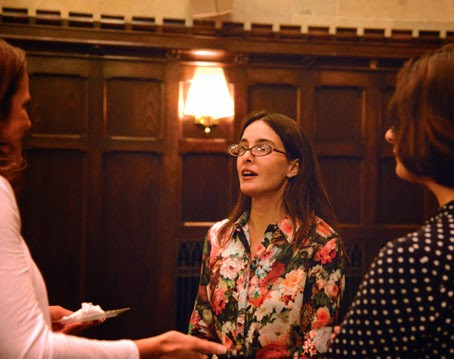
“I was watching their passion for critiquing hookup culture once they figured out they weren’t alone, about how before they pretended it was awesome, but how it’s actually kind of awful,” Freitas told to a gathering of Fordham alumni, students, and faculty in Tognino Hall on Sept. 8. “They felt like they had been abandoned by the Catholic tradition to wallow in college without anything useful or practical to [guide] them. They wanted guidance.”

Curious to know if other students felt the same way, Freitas began crisscrossing the country visiting four types of colleges—Catholic, evangelical Christian, private, and public—to study students’ attitudes about sex and faith. She shared her findings in her book Sex & the Soul: Juggling Sexuality, Spirituality, Romance, and Religion on America’s College Campuses (Oxford University Press, 2008).

As part of Freitas’ study, more than 2,500 college students at seven campuses participated in an online survey, and she conducted one-on-one interviews with more than 100 students. She found that while students were interested in spirituality, and 80 percent of them identified as “spiritual, or religious to some degree, “even at a non-religious affiliated college, they often felt uncomfortable speaking about it outside the classroom setting.

It was much the same way with dating; students were interested in finding romance, but were hesitant to act upon their desires or even talk about it with friends and peers. “Students would say, ‘I want romance but I can’t admit that.’ Or ‘My parents did that, but that doesn’t really happen in my generation anymore.’ It was an anxiety around a wish for dating, but also this anxiety around [dating],” said Freitas, now a research associate in the Center for the Study of Religion and Society at the University of Notre Dame.

Freitas said 78 percent of the students she surveyed saw romance as “virtually asexual.” “Students very rarely—I can’t tell you how very rarely—talked about sex and love together,” she said. For these students, sex was a casual act, and they thought their peers thought the same thing: 45 percent of students at Catholic colleges and 36 percent at nonreligious private and public schools said their peers are “too casual” about sex; an additional group, 35 percent at Catholic colleges and 42 percent at nonreligious private and public schools, reported that their peers are “simply casual” about sex.

“It’s become a hookup culture,” Freitas said, noting that a hookup, according to students, meets three criteria: It involves some form of sexual intimacy, anything from kissing to sex; it’s a brief experience; and it’s free of emotional attachment. Freitas found that students often described hookups as “efficient,” feel they are too busy in college to develop and maintain relationships, and so they consider hookups “efficient.”

Nevertheless, 41 percent of those students who reported personal experiences with hooking up said they were “profoundly upset about this behavior,” and used words such as “awkward, dirty, miserable, empty, alone, disgusted, ashamed” to describe those occurrences. An additional 23 percent expressed ambivalence about hooking up, saying, “‘Hooking up is whatever; it makes me feel whatever,’” leading Freitas to term that group the “whateverists.” The remaining 36 percent labeled it as “fine.”

Students are not against hooking up, said Freitas, but “they’re unhappy with the culture” that breeds ambivalence and indifference “[Students] today are learning to steel themselves against connection, learning to shut down in order to be sexually intimate,” she said. “They are getting better at hookup culture, but I’m not sure we should be happy about that.”

Freitas raised concern about the relationship of hookup culture to sexual assault. If students are hooking up, “to have ‘efficient’ sexual intimacy, and to not get attached,” communication between the two individuals involved can be limited or even disregarded, “[making] the idea of consent very complicated,” she said.

“What does consent look like in a culture where when we are sexually intimate we are also discouraged from communicating?”

And yet, Freitas said, students who are propagating the hookup culture “want love and they want meaningful sex.” said Freitas.

Many hope to find that connection through spirituality, which they consider “much more forgiving, much more open, much more inclusive than religion.”

She heard over and over from students at Catholic colleges that “sex and religion don’t mix” and “religious teaching on sex are outdated.” In the face of peer pressure and mainstream American cultural attitudes about sex, she said students are struggling to reconcile their sexuality with their faith.

Freitas suggested that Catholic colleges, with their “extraordinarily rich history in spirituality and practices” be more creative and open in offering retreats, spiritual direction, social justice programming, and other resources to encourage students to examine the relationship between sexuality and spirituality—particularly within the campus community.

“When you start asking those questions in your own community, you have to contend with hookup culture, you have to contend with sexual assault,” said Freitas. “The tradition obliges you.”

The event was sponsored by the Graduate School of Religion and Religious Education.

—Rachel Buttner

Monday, September 22, 2014

Faculty Reads: Neuroplasticity — Rewiring the Brain to Lower Anxiety

A Fordham professor is using pioneering neuroscience research on the brain’s ability to change to help pastoral counselors address clients’ anxiety.

In his latest book, The Power of Neuroplasticity for Pastoral and Spiritual Care (Lexington Books, 2014), Dr. Kirk Bingaman, an associate professor of pastoral care and counseling, explores the impact that an adaptive mechanism known as “the negativity bias” has on our wellbeing. An evolutionary cousin of the “fight or flight” phenomenon, this bias describes the brain’s propensity to experience negative events more intensely in order to alert us to potential danger.

A built-in negativity bias was vital when humans lived as hunter-gatherers ever-at-the-ready to flee from a hungry lion. In today’s world, however, this bias tends to cause excessive negativity and anxiety.

“Today [this] anxiety spills over into our relationships with others and with ourselves,” said Bingaman, who teaches in Fordham’s Graduate School of Religion and Religious Education. “It causes us to assume the worst, to overact to situations in ways such as, ‘Why did you look at me this way? Why did you use that tone?’”

Fortunately, Bingaman says, we are not condemned to primal negativity, thanks to the human brain’s capacity to change across the lifespan. With every new experience — learning new information, creating a memory, or adapting to a new situation — the brain undergoes structural changes, generating new neural pathways and reshaping existing ones. This ability, known as neuroplasticity, forms the crux of Bingaman’s book.

He argues that the most effective way to harness the power of neuroplasticity is through mindfulness meditation and contemplative spiritual practice. Through these therapeutic techniques and spiritual practices, clients learn to become aware of their thoughts and feelings. Rather than reacting to or trying to eliminate them, clients simply observe them as they come and go.

“Thoughts and feelings have a 90-second shelf-life biochemically. So when we experience an anxious thought or feeling, it will dissipate from the blood in 90 seconds — unless we feed the thought or judge ourselves for feeling that way,” he said. “The key to mindfulness-based therapy is to let thoughts and feelings come and go without fighting them. This then reduces the limbic activity in our brains and calms the amygdala.”

Himself a pastoral counselor, Bingaman says that the science of neuroplasticity will “necessitate a paradigm shift” in the way pastoral and spiritual caregivers approach their work with clients and congregants.

“Whether it’s therapy or theology, we need to really look at the frames of reference we are using to help the person in our care to calm their anxious brain. Some of our approaches are going to fire up the limbic region, and others will do the reverse.

“We have to make more use of it in religious and spiritual circles,” he continued. “Finding a regular contemplative practice is not something just for the mystics off in the desert. It’s for you and me and everyone else.”

— Joanna Mercuri

Friday, May 16, 2014

Careers in Ministry

Are you interested in learning more about a career in ministry?

C. Colt Anderson, Ph.D., the dean of Fordham’s Graduate School of Religion and Religious Education (GRE), will host a discussion and Q&A for those interested in the field of ministry.

Careers in Ministry
Thursday, May 22, 2014
12 p.m. to 1:30 p.m.
Room 520 | Lowenstein Center | Lincoln Center Campus

Light refreshments will be served. Please RSVP by May 19 to gre@fordham.edu.

For more info, click here.

— Joanna Klimaski

Friday, November 19, 2010

What is Entrepreneurial Discipleship?

A new model of the church that harnesses collective innovation, community-based initiative and creativity to respond to the calling of Christ.

• WHO: Robert Brancatelli, Ph.D., visiting professor at the Graduate School of Religion and Religious Education, and David Gautschi, Ph.D., dean of the Graduate School of Business Administration.
• WHAT: A lecture discussing Entrepreneurial Discipleship
• WHEN: 7:30 p.m. on Nov. 29
• WHERE: St. Francis of Assisi Church at 135 W. 31st St.

The lecture is sponsored by the Graduate School of Religion and Religious Education. For more information, visit www.fordham.edu/gre or call (718) 817-4800.

Tuesday, January 12, 2010

Father Ryan Reports from West Africa (VIII): "Winding Up in Ghana"

Laurence J. McGinley Professor of Religion and Society Patrick J. Ryan, S.J. is spending a month in Africa, a continent where he previously lived for 26 years. During his time there, he will be blogging about his experiences. Here is his latest post:

Since last Saturday, Jan. 9, I have been meeting with old friends whom I originally knew at the University of Ghana. The Reverend Joyce Kodade, a Presbyterian minister (a man, like Joyce Kilmer and Joyce Cary), was my student in his final year (1975-76). He eventually did a master's degree at Fordham's Graduate School of Religion and Religious Education (1985-87). He is now a major administrator of the Evangelical Presbyterian Church in Ghana.

I celebrated mass on Sunday morning in an "out-station" I began with 12 adults and about 30 children in December 1974. We started in a classroom, but now the parishioners (about 1,000 in number) worship in a church they have built and dedicated to my patron saint, St. Patrick. As soon as they build a presbytery, it will become a full parish. The offertory procession, involving all in church, was conducted to an African beat and brought up not only cash donations but also foodstuffs, candles, bottled water, toilet paper and soap. This helps their pastor, Father Agbattey, to survive. Like most masses in Africa, it began a bit late but (happily, given the heat) only lasted 90 minutes.

On Monday, I had lunch with another friend from those days, Professor John Pobee, once my head of department. Late in life, he was ordained to the Anglican priesthood and is now the Vicar General of the Diocese of Accra. He also worked for 19 years in Geneva for the World Council of Churches's program for ecumenical theological education.

Today I had lunch with a former registrar of the University of Ghana (who also worked as a registrar later on In Rwanda), Ebow Daniel. I have a particularly poignant bond with him and his wife, Theresa. On my 40th birthday, I had the sad duty of burying their eldest son, a 12-year-old, who had died suddenly of an asthma attack.

I return to Nigeria tomorrow, Jan. 13, and to New York on Jan. 16. Alas, I will miss the Jan. 14 funeral of my friend and former Provincial, Father Joe Novak. May he rest in peace.

-- Pat Ryan, S.J.

Friday, January 8, 2010

Father Ryan Reports from West Africa (VII): "Planning Ahead"

Laurence J. McGinley Professor of Religion and Society Patrick J. Ryan, S.J. is spending a month in Africa, a continent where he previously lived for 26 years. During his time there, he will be blogging about his experiences. Here is his latest post:

I am still in Ghana, as I have been since Dec. 28, but will return to Nigeria on Jan. 13 and fly out of Nigeria to New York on the night of Jan. 15. I expect that the search at the airport in Abuja will be more extensive than it was for my flight from Lagos to Accra.

I am reading ahead for next semester, just having finished a book on the ethical and political problems involved in humanitarian assistance. During the spring break I am scheduled to give a course for Fordham's Institute for International Humanitarian Affairs on this topic.

In 1983, various relief agencies flew in supplies to Ghana for half a million Ghanaians deported from Nigeria in January of that year. Among other things, huge army field tents were sent in on the mistaken notion that these deportees would be shelterless. Nobody lacked a relative on whose floor, at least, he or she could sleep, so the huge tents were finally used by solitary night watchmen standing guard at places like the Catholic Secretariat in Accra.

Some of the supplies flown in proved very useful in Ghanaian hospitals, such as baby formula, which was in short supply. On the presumption that I knew Italian (at the time I did not, but have since learned it in Rome), I was asked to come to the staff and student hospital of the University of Ghana to translate the directions on cans. With Latin and French, I managed to figure them out. No one died as a result.

I am also re-reading Lamin Sanneh's fascinating study of the impact of mission on culture, "Translating the Message." The book is assigned for a course I am teaching in the Graduate School of Religion and Religious Education this spring. Lamin, together with his wife Sandra, have been close friends since 1975 when we were colleagues at the University of Ghana. He and she both teach at Yale now.

I offered mass yesterday evening for Fr. McShane's brother, Jack, who died suddenly on Jan 6. May he rest in peace.

—Pat Ryan, S.J.