Fordham Notes: Fordham University Press
Showing posts with label Fordham University Press. Show all posts

Thursday, September 4, 2014

How Air Conditioning Changed Everything


As the mild summer winds to a close, New Yorkers can appreciate that Mother Nature was much gentler this past season than this past winter. There was little need to crank up the air conditioning, until this week when the temperature finally hit 90 degrees. But when the relief was needed, it was there.

Few recognize the benefits of air-conditioning unless it’s not working, said Salvatore Basile, author of Cool: How Air Conditioning Changed Everythingreleased this week by Fordham University Press.

It was just one such moment when Basile’s air conditioner “went on the blink” that he found the inspiration to write the book.

“I realized that nowadays we have so much access,” he said. “If it’s too hot, you duck into a shop or you go to work to cool off and escape from the heat, but what about the time when there was no air conditioning at all, how did people deal?”

Cool explores thousands of years history of humankind attempting to cool down: from waterpower of ancient times, to the “Apparatus for Treating Air” of the early 20th century, to Portland, Oregon’s Equitable Savings and Loan Building, one of the first buildings to be effectively sealed and air conditioned.

But Basile said that air conditioning has done far more than provide relief from the heat. It has radically revolutionized the appearance of cities worldwide. Before air conditioning, laws stipulated that a worker’s desk couldn’t be more than 25 feet from an open window. He said that much of what we consider to be modern architecture, like the Equitable Savings, was made possible through centralized climate control systems. Not only did the air conditioning allow for more building girth, but it also allowed for glass curtain walls.

Author Salvatore Basile
Now that there are few operable windows in office towers, Basile said there is a growing trend to incorporate unadulterated fresh air back into building design via operable windows. He cited architect Noman Foster’s “Gherkin” in London as one example. He added that for some, air conditioning represents “an invasion of personal freedom.”

Despite his own pro-cool stance, Basile gives equal airtime to naysayers, particularly concerning the technology’s role in global warming. Nevertheless, he has been an unabashed aficionado of cool currents since he was a kid.

“My first contact was when I was six, when my aunt Catherine bought two [air conditioners],” he said. “Everybody thought this was very racy behavior, but we all went to her house when it got hot.”

There will be celebratory book launch for Cool on Tuesday, September 9 from 6 p.m. to 8 p.m. in the Atrium of the Lowenstein Building at Lincoln Center.

-Tom Stoelker

Wednesday, May 28, 2014

Fordham professor: Maya Angelou gave us permission to 'love ourselves'

Celebrated poet and essayist Maya Angelou died Wednesday at the age of 86.

As a poet, educator, historian, best-selling author, actress, playwright, civil-rights activist, producer and director, Angelou was hailed as one of the great voices of contemporary literature.

Though she never made an appearance at Fordham, Angelou wrote a closing poem for a book edited by Kevin M. Cahill, director of the Institute of International Humanitarian Affairs.

Angelou wrote, “Life Doesn’t Frighten Me,” for Even in Chaos:Education in Times of Emergency (Fordham University Press, 2010), a book that focuses on the need for humanitarian workers to place education on an equal footing with medical care in refugee camps, and to protect camp schools from attacks by militias.

"I told her, 'I want you to get me back to the innocence of the children,' and she gave the book a beautiful ending," Cahill told Fordham in 2010.


In 2008, Angelou gave a speech at nearby Pace University in 2008. Alumna and poet Liz Bowen (FCLC '11), then the editor-in-chief of The Observer, Fordham’s student newspaper for the Lincoln Center campus, covered the talk.

We asked one of our faculty members to share her thoughts on Maya Angelou:

“As a middle schooler in Cincinnati, Ohio, I was bombarded with images, words, and ideas that rarely reflected my experience. When we (Black girls and boys) discovered Maya Angelou, we found a way to write ourselves in, we were given permission to love ourselves despite the ways we were silenced and unseen. She revealed that the blueprint for loving all human beings could be found in our ability to live our lives without fear. May she rest in the beauty and power she created,” said Aimee Meredith Cox, culture anthropologist and assistant professor of performance and African American Studies.

-Gina Vergel


Wednesday, April 9, 2014

University Press Editor Remembered by Friends and Family


In times of grief, words sometimes fail us.

Such was the case with French philosopher and author Jean-Luc Nancy, upon hearing of Helen Tartar’s untimely March 3rd death: “I have no words, no voice,” he wrote to Tartar’s husband, Bud Bynack. 

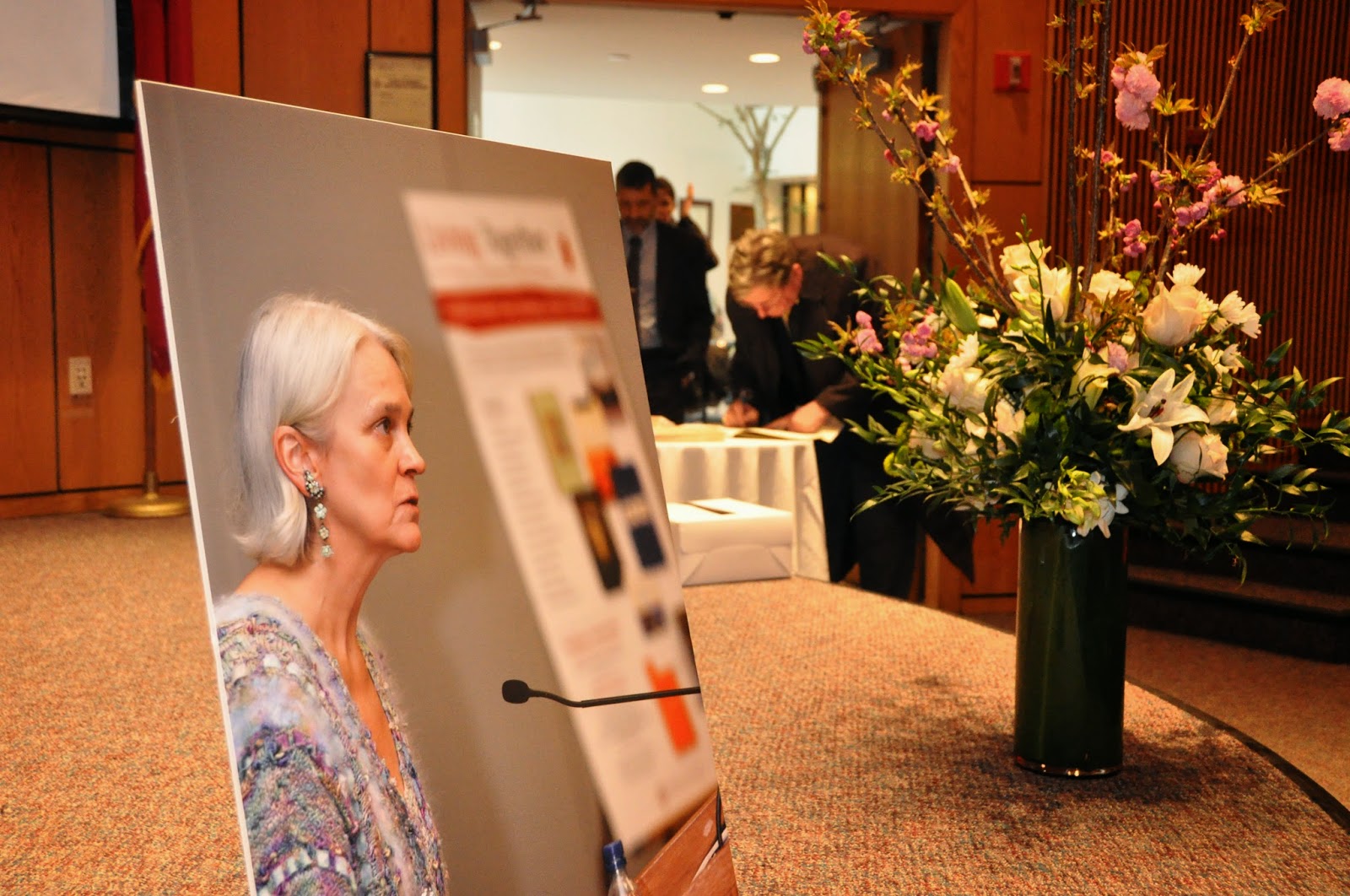
But where words might fail at capturing the life of Tartar, there are plenty of books: In her lifetime, the editorial director at Fordham University Press (FUP) helped shape and publish more than 600 scholarly books—many of which were on display in a rotating slideshow at a memorial held on April 8 at Fordham.

The event attracted 100 of Tartar’s authors, associates, family, friends, and fans, as her formative talent as an editor and her dedication as a mentor was recalled through emails, anecdotes, poetry, and passages from her own speeches. Tartar was killed suddenly in an automobile accident in Colorado on March 3rd. 

Co-worker Fred Nachbaur, director of FUP, described Tartar as one of those individuals who “add more light to the world than they take from it.” Nachbaur read several emails that he’d received from colleagues, upon hearing of Tartar’s death, in which she was recalled a person who took intellectual risks, who had a strong and nurturing influence on new writers, and whose sublime spirit understood well the humane priorities of life.

She was also someone, he said, that would have loved the act of friends remembering her through words.

“When I think of Helen, I think of words,” said Nachbaur, who was wearing a scarf that Tartar—an avid knitter—had presented him on a recent campus snow day. “Helen loved words so much that she found it difficult to end a conversation.” 


She also loved the printed book, he said, so much that she “bridled” at the suggestion of an e-book “but she also understood there was a market for it.”

Bynack, Tartar’s husband of 41 years, described Tartar’s upbringing in rural Oysterville, Washington, recalling the influence of her parents (her mother was one of the first female Naval officers in WW II; her father was a research biologist and university professor.) At age 18, he said, she grabbed the “first train smoking out of town” and landed at Swarthmore College, which nurtured her intellectual appetite. After earning two master’s degrees at Yale, she found success in academic publishing—first at Stanford and then Fordham. 

“She was the best-educated person I’ve ever met,” he said.

After a controversial departure from Stanford, Tartar found Fordham to be a “sanctuary” where the University’s mission and her vision for a press found a rich meeting of the minds.

“Her life was scholarly publishing; it’s what she lived for, he said. “Fordham gave it back to her.”

Fordham Provost Stephen Freedman called her “a star, a luminary in the field of academic publishing” and someone who was instrumental in raising FUP’s national and international profile. 

Author and philosopher Judith Butler, Fordham English professor Christopher GoGwlit, poet and author Kyoo Lee, and FUP co-worker Tom Lay also gave remarks at the memorial.

All the while a silent screen of images of rotating book covers offered a visual testimonial beyond words. 

“She was working for us,” summed up Butler, who had attended Yale with Tartar and who published her books with Tartar. “She gathers us, and gathers us still, and it is only now we realize how many of us there are.”

Fordham has established the Helen Tartar Memorial Fund, c/o Fordham University Development and University Relations, 888 Seventh Avenue, 7th Floor, New York, NY 10019.


 -- Janet Sassi


Wednesday, January 8, 2014

Roundup: Fordham Professors Quoted in the Media

Gold medalist skier Lindsay Vonn will miss the Sochi Olympics.
When it comes to news stories dealing with sports business or law, chances are Mark Conrad, associate professor of law and ethics, has an opinion.

Conrad, who oversees the sports business specialization at the Gabelli School of Business, was quoted in an article on CNBC.com about what the absence of gold medalist skier Lindsay Vonn means for the Sochi Olympics. (Vonn will skip the competition due to a knee injury):

"She's highly marketable, and without her I would expect interest in the games from U.S. viewers to drop," said Mark Conrad, professor of sports law at Fordham University.
...
"There aren't that many well-known American athletes in the games, and she was probably the major draw," he said.

Conrad was also quoted in the New York Times about a lawsuit settlement which will allow former National Football League players suffering from health problems to receive as much as $5 million each.

According to the Times, some former players have indicated that the settlement is insufficient and are inclined to turn it down because they say not enough money will be available for players struggling with memory loss, anger management and other problems.

Still, Conrad doesn’t see too many former players opting out:

“I think this is pretty much a done deal,” said Mark Conrad, who teaches sports law at the Gabelli and Graduate Schools of Business at Fordham University. “Are people going to go to litigation by themselves and spend years doing this? I thought the $760 million was too low, but time is not on the side of people with these conditions.”

Read the rest of the article here.

Over on the local politics side of things, New York City welcomed its first new mayor in more than a decade, and Christina Greer, assistant professor of political science, has kept busy giving interviews.


Former President Clinton swears in new mayor Bill de Blasio.
Image via The Nation.

Greer provided live analysis on NY1 during Mayor Bill  de Blasio’s inauguration (it was cold one! See video here). She also penned an opinion piece for The New York Times’ “Room for Debate” section, which asked if speakers at the Jan. 1st inaugural were rude to the former mayor or just “voicing the frustrations of millions of New Yorkers who are rarely heard.”

Mayor Bloomberg wasn't smiling in the inauguration.
Image via Daily News.
Greer wrote:

“If anyone expected the inauguration of the first Democratic mayor in 20 years to serve as an occasion to celebrate the accomplishments of his predecessor, Michael Bloomberg, while ignoring the issues of stop-and-frisk, homelessness, hyper-development of neighborhoods and rising inequities in general, they were sorely mistaken.”

Still, DeBlasio has a lot to prove, Greer added:

“It is now up to Mayor de Blasio to make his promises a reality. If not, he will be the one sitting bundled up on a cold January day in 2018, listening to future poets, activists and politicians go on about how he disappointed New Yorkers.”

Read the entire piece, and the opinions of others who weighed in on the same topic, here.

Greer, author of Black Ethnics: Race, Immigration, and the Pursuit of the American Dream (Oxford University Press, 2013), also weighed in on another change in New York: an apparent shift by New York Gov. Andrew Cuomo (FCRH '79) on medical marijuana. Read that story here.

Finally, in other media clips news related to Fordham and the new mayor, a Dec. 13 article in The New York Times included a book published by Fordham University Press as “suggested reading for de Blasio:”

“The Accidental Playground: Brooklyn Waterfront Narratives of the Undesigned and Unplanned” (Fordham University Press). Daniel Campo, a former New York City planner, considers the serendipitous development of Williamsburg and concludes: “In contrast to urban space produced through conventional planning and design, the accidental playground that evolved on the North Brooklyn waterfront generated vitality through immediate and largely unmeditated action. The waterfront was there for the claiming, and people went out and did just that without asking for permission, holding meetings or making plans.”

See the rest of the list here.

-Gina Vergel

Monday, May 23, 2011

Chronicle Notes Fordham University Press Book on Primo Levi

The Chronicle of Higher Education had this to say about Answering Auschwitz: Primo Levi's Science and Humanism After the Fall:

One triumph of scholarship, however, is that it can ride the force of established reputation like a wave, and take us into new dimensions of a writer or subject. At first glance, Answering Auschwitz: Primo Levi's Science and Humanism After the Fall, a new collection of essays edited by Stanislao G. Pugliese (Fordham University Press, 2011), looks to be more of the same—another deserved monument to 20th-century literature's most disciplined witness to the Holocaust, that flinty, unsentimental voice like no other. But Pugliese, a professor of modern European history and Italian studies at Hofstra University, offers us a fuller portrait.

The book was published in March by Fordham University Press.

Friday, March 11, 2011

Voices Up: Songs for James Joyce & Hart Crane

The Voices Up premiere of Songs for Joyce by Samuel Barber and Victoria Bond, and Songs for Crane by Elliott Carter, Lawrence Kramer and Alexander Nohai-Seaman.

Friday, March 11, 2011 | 7:30 p.m.
Lowenstein Center | 12th-Floor Lounge
Fordham University, Lincoln Center Campus
Free and Open to the Public

Joyce, Crane, and Fordham University Press
This event is held in collaboration with Fordham's Poet's Out Loud program and will (as all Voices Up events do) feature live readings of the texts set to music. This year's event commemorates the publication, by Fordham University Press, of the first critical edition of Hart Crane's epic of America, The Bridge, edited by Lawrence Kramer, professor of English at Fordham, and the 2011 edition of Joyce Studies Annual, edited by Moshe Gold and Philip Sicker. Books will be available at the concert.

Thursday, January 13, 2011

Fordham University Press joins Oxford UP ebook Distribution Platform

Fordham University Press has joined a groundbreaking new online platform developed by Oxford University Press.

University Press Scholarship Online (UPSO) is a fully enabled XML environment for university press monograph content that features cutting edge search and discovery functionality.

“The expansion of Oxford Scholarship Online to include the research and scholarship of other university presses, creating a single platform searchable across many high-quality programs, represents a step forward in ensuring that academic content is increasingly accessible—and conveniently so,” said Tim Barton, Managing Director of Global Academic Business for Oxford University Press.

Responding to increased demand for online scholarly content, UPSO streamlines the research process by making disparately published monographs easily accessible, highly discoverable and fully cross-searchable via one online platform. Research that previously would have required users to jump between a variety of books, and disconnected websites can now be concentrated through a single search engine.

For more information, visit Fordham ImPRESSions, the Fordham University Press blog.

—Gina Vergel

Thursday, June 3, 2010

University Press Musical Performance and Book Reading

Fordham University Press
June 8, 2010 | 6 p.m. | Barnes & Noble | 555 Fifth Avenue | New York, NY 10017

Thursday, February 11, 2010

Red Tail Captured, Red Tail Free

In honor of Black History Month, Fordham University Press is featuring Red Tail Captured, Red Tail Free: Memoirs of a Tuskegee Airman and POW, by Alexander Jefferson, one of 32 Tuskegee Airmen from the 332nd Fighter Group to be shot down in World War II.

A Detroit native, Jefferson enlisted in 1942, trained at Tuskegee Institute, Alabama, became a second lieutenant in 1943, and joined one of the most decorated fighting units in the War, flying P51s with their legendary, and feared, “red tails.”

Based in Italy, Jefferson flew bomber escort missions over southern Europe before being shot down in France in 1944. Captured, he spent the balance of the war in Luftwaffe prison camps in Sagan and Moosberg, Germany.

Buy a copy direct from FUP
.

Sunday, December 27, 2009

Father Ryan Reports from West Africa (IV): "Fordham and Nigeria"

Laurence J. McGinley Professor of Religion and Society Patrick J. Ryan, S.J. is spending a month in Africa, a continent where he previously lived for 26 years. During his time there, he will be blogging about his experiences. Here is his fourth post:

Over the years, many Nigerians have studied at Fordham, most notably in the Graduate School of Religion and Religious Education, but also in nearly every other School as well. What few people now realize is the connection between Fordham and the original coming of Jesuits to Nigeria.


The Catholic Bishops of Nigeria asked for Jesuit professors to help in the foundation of the state-run University of Lagos at its inception in 1962. UNESCO asked NYU and Fordham for academic staff as well. The first Jesuit to come, who had a Ph.D. from Fordham in biology but was teaching at St Peter's College in Jersey City, was Father Joseph Schuh. A year later two other Jesuits came: Father Joseph Schuyler, who had a Fordham Ph.D. in sociology and was teaching at Fordham's seminary campus in Shrub Oak, N.Y.; and Father Joseph McKenna, who had a Ph.D. From Yale and was the head of the political science department at Fordham.


Schuh returned to St. Peter's in 1965 but Schuyler remained at Unilag, as it is called, until his retirement in 1986. He stayed another nine years beyond that in pastoral work in Lagos until health reasons mandated his return to the U.S. in 1995. McKenna never actually taught at Unilag --many Nigerians have Ph.D.s in political science--but fulfilled many roles for the bishops and the Jesuits in Nigeria until 1984, when he retired back to other Jesuit assignments around Fordham. In 1997, Fordham University Press published a study he did on varieties of Marxism in Africa and the response of the Catholic Church to that phase in recent African history.


All three Joes did Fordham proud over the years. McKenna's 1969 essay in Foreign Affairs on prospects for peace after the Nigerian civil war, published when the war was still ongoing, drew praise from the federal government of Nigeria at the time.


I arrived in Nigeria with three other Jesuits in 1964, just after I had finished an M.A. in English at Fordham; the degree was awarded in February 1965 while I was in Nigeria. I taught English in a Catholic but non-Jesuit high school in Nigeria in 1964-65. On this trip, I found myself sleeping on Christmas Eve in the same house where I slept on Christmas Eve of 1964. On Christmas Day, I had lunch in a Chinese restaurant with the best student I taught back then, Anthony Akingbade, now a 61-year-old medical doctor who eventually did his undergraduate studies at Harvard and his medical formation at Albert Einstein College of Medicine, our Bronx neighbor.


-- Pat Ryan, S.J.

Tuesday, September 22, 2009

Fordham University Press Rolls Out Blog

Fordham University Press debuts its blog today, FORDHAM IMPRESSIONS. The blog features entries by press authors, announcements and features on forthcoming books, among other items.

Fredric W. Nachbaur was appointed the press's new director in January. The press publishes an average of 30 to 40 titles per year, with roughly $1 million in annual sales.

The press publishes primarily in the humanities and the social sciences, with an emphasis on the fields of anthropology, philosophy, theology, history, classics, communications, economics, sociology, business, political science, and law, as well as literature and the fine arts. Additionally, the press publishes books focusing on the metropolitan New York region and books of interest to the general public.

Friday, August 21, 2009

Press Celebrates Grand Concourse Birthday

Intersections: The Grand Concourse at 100, published by Fordham University Press, celebrates the history of the famous Bronx boulevard through a collection of pieces written by historians and contemporary museum curators.

The book, edited by Antonio Sergio Bessa, includes two original texts by Alsatian-born engineer Louis Risse, who designed and oversaw the construction of the Grand Concourse. It is co-published with the Bronx Museum of the Arts, where Bessa is director of programming.

November 2009 marks the 100th anniversary of the Grand Boulevard and Concourse, which stretches more than four miles from 138th Street to the Mosholu Parkway. The Concourse was modeled on the Champs Élysées in Paris and described in the 1939 WPA Guide to New York as “the Park Avenue of the middle-class,” it offered residents amenities not seen before in the city, including private bathrooms and central heating.